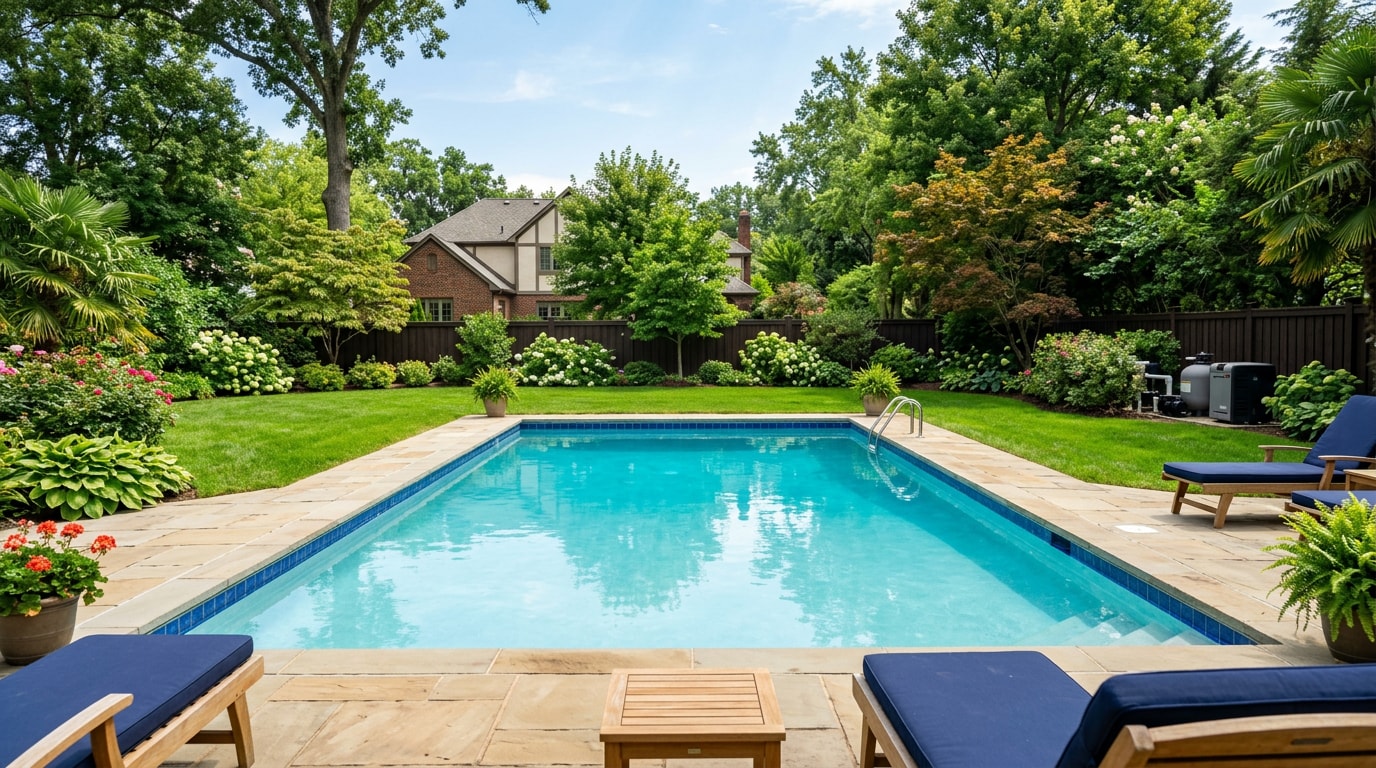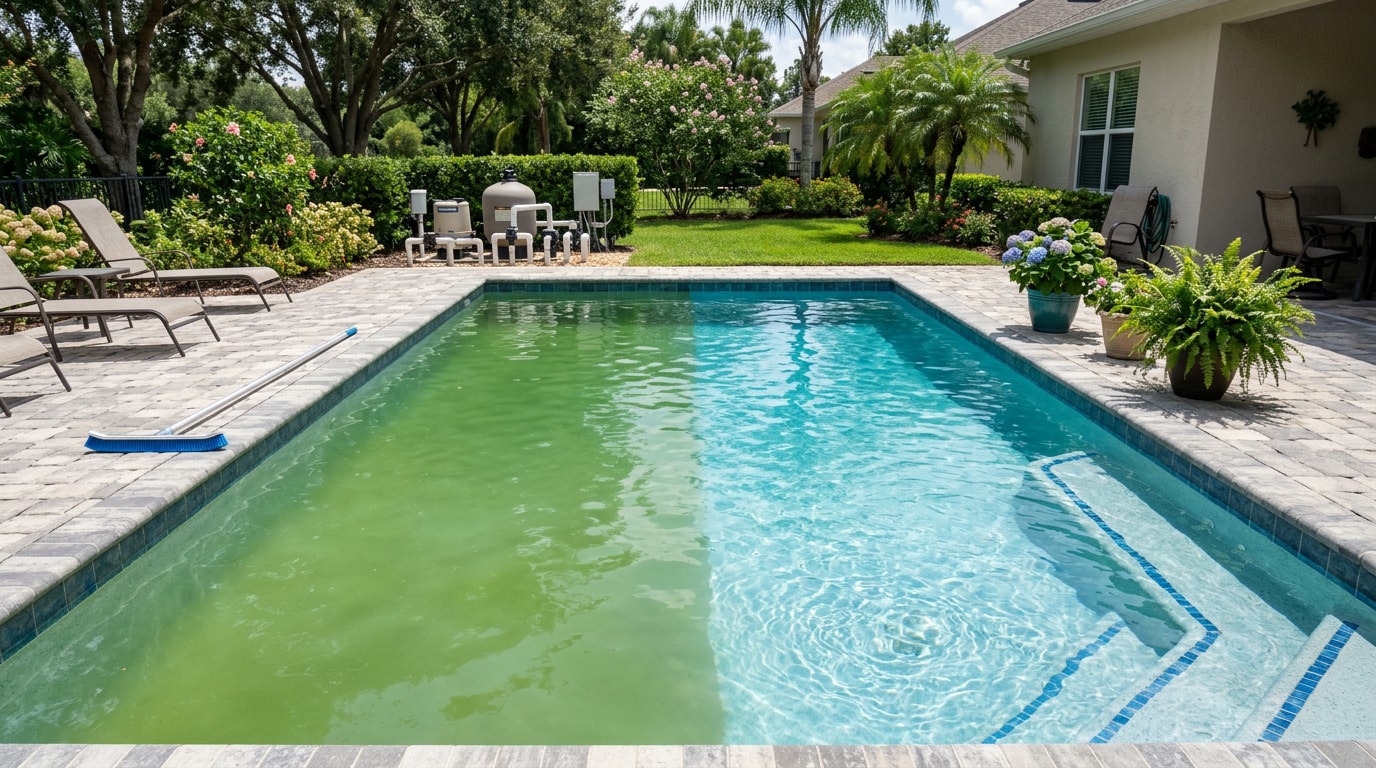

A pool water tester in Gainesville, GA is the difference between catching a chemistry problem while it's a five-minute fix and discovering it after your liner, heater, or pump has already paid the price. Every parameter in your pool interacts with the others, so skipping one test often means chasing a mystery problem later. This guide breaks down exactly what to test, how often, and when it's worth handing the sample to a professional.
Why Pool Water Testing Matters
Low chlorine lets bacteria and algae take hold. High pH makes chlorine less effective, and swimmers feel it in their skin and eyes.
Low alkalinity lets pH swing wildly after a storm. High calcium hardness leaves scale on tile, heaters, and pumps.
Balanced water protects more than comfort. It protects pumps, heaters, and liners from corroding or scaling years ahead of schedule.
The stakes go beyond equipment, too. Public health officials reported 208 outbreaks associated with treated recreational water over a five-year surveillance period, resulting in at least 3,646 cases of illness, with almost all of those outbreaks tied to public pools, hot tubs, or water playgrounds. Backyard pools aren't included in that federal count, but the underlying chemistry rules are the same: unchecked water doesn't stay safe on its own.
What a Complete Pool Water Test Should Cover
A real pool water test covers more than chlorine. Each number below tells part of the story, and ignoring one throws off the rest.
- Free chlorine – the active sanitizer that kills bacteria and algae
- pH – how acidic or basic the water is, affecting comfort and sanitizer strength
- Total alkalinity – a buffer that keeps pH from swinging after rain or heavy use
- Calcium hardness – mineral content that corrodes surfaces if too low or scales equipment if too high
- Cyanuric acid – a stabilizer that shields chlorine from breaking down in sunlight
- Salt – relevant only for pools running a saltwater chlorine generator
Gainesville's climate adds its own wrinkle. Heavy North Georgia afternoon storms dilute chemicals and swing pH fast. Summer humidity and heavier bather loads burn through free chlorine quicker than drier climates typically see.
Routine testing, backed by professional pool and spa maintenance when levels drift, keeps chemical levels steady through those swings. If your pool runs on a salt system, a slipping salt reading is also worth a look at your saltwater pool conversion equipment before it affects sanitizer output.
Ideal Pool Water Chemistry Ranges (Target Numbers)
Target ranges call for free chlorine between 1.0 and 5.0 ppm with pools centering around 2.0 to 4.0 ppm, a pH of 7.2 to 7.8 with pools targeting 7.4 to 7.6, total alkalinity between 60 and 180 ppm with pools targeting 80 to 120 ppm, calcium hardness between 150 and 1,000 ppm with pools targeting 200 to 400 ppm, and cyanuric acid at 30 to 50 ppm. Most residential pool owners aim for the tighter target bands below rather than the outer limits:
| Parameter | Target Range |
|---|---|
| Free chlorine | 1–3 ppm |
| pH | 7.4–7.6 |
| Total alkalinity | 80–120 ppm |
| Calcium hardness | 200–400 ppm |
| Cyanuric acid | 30–50 ppm |
Test pH before chlorine. Skewed pH can throw off chlorine reagent color reactions, leading to an inaccurate reading.
Pool Water Testing Methods: Strips, Liquid Kits, and Professional Analysis
Gainesville pool owners typically choose from three testing methods. Each involves a tradeoff between speed, cost, and accuracy.
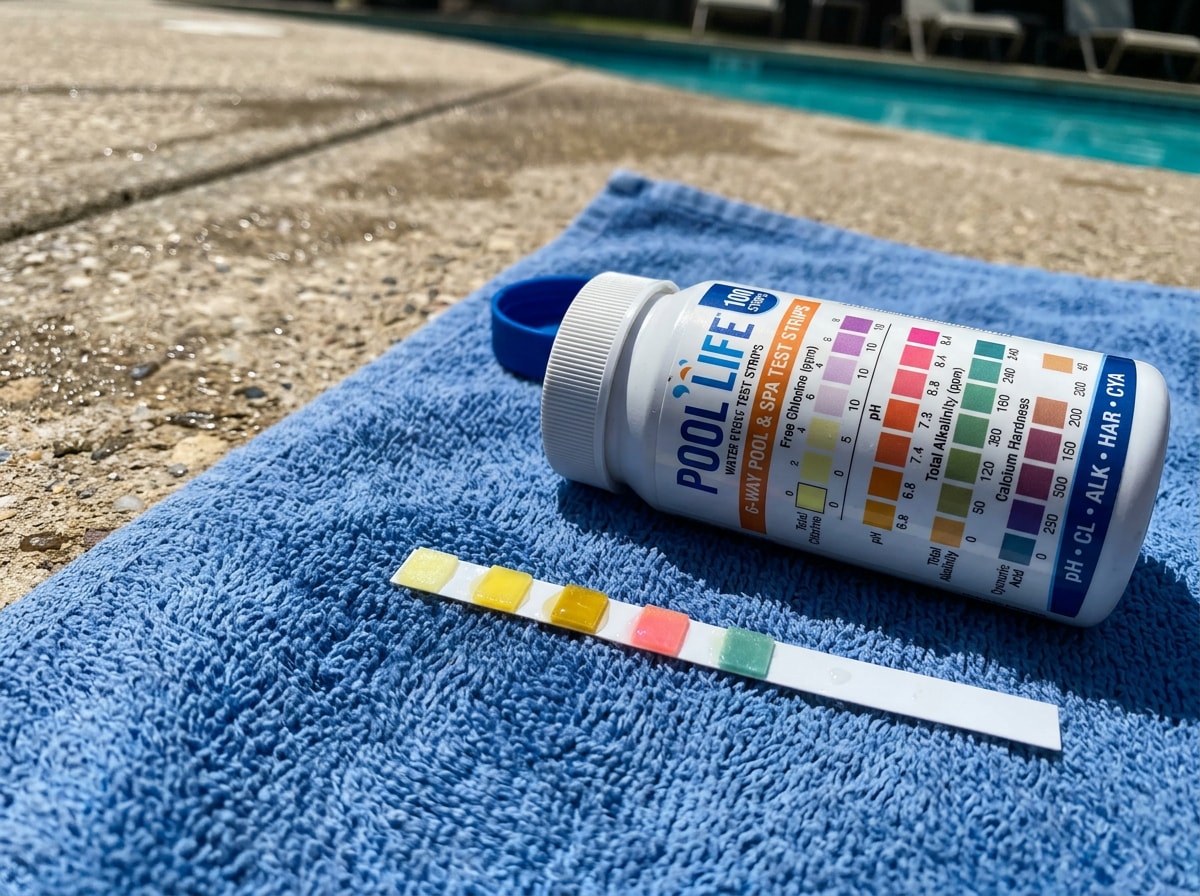
- Test strips – fastest and cheapest, good for a quick daily snapshot
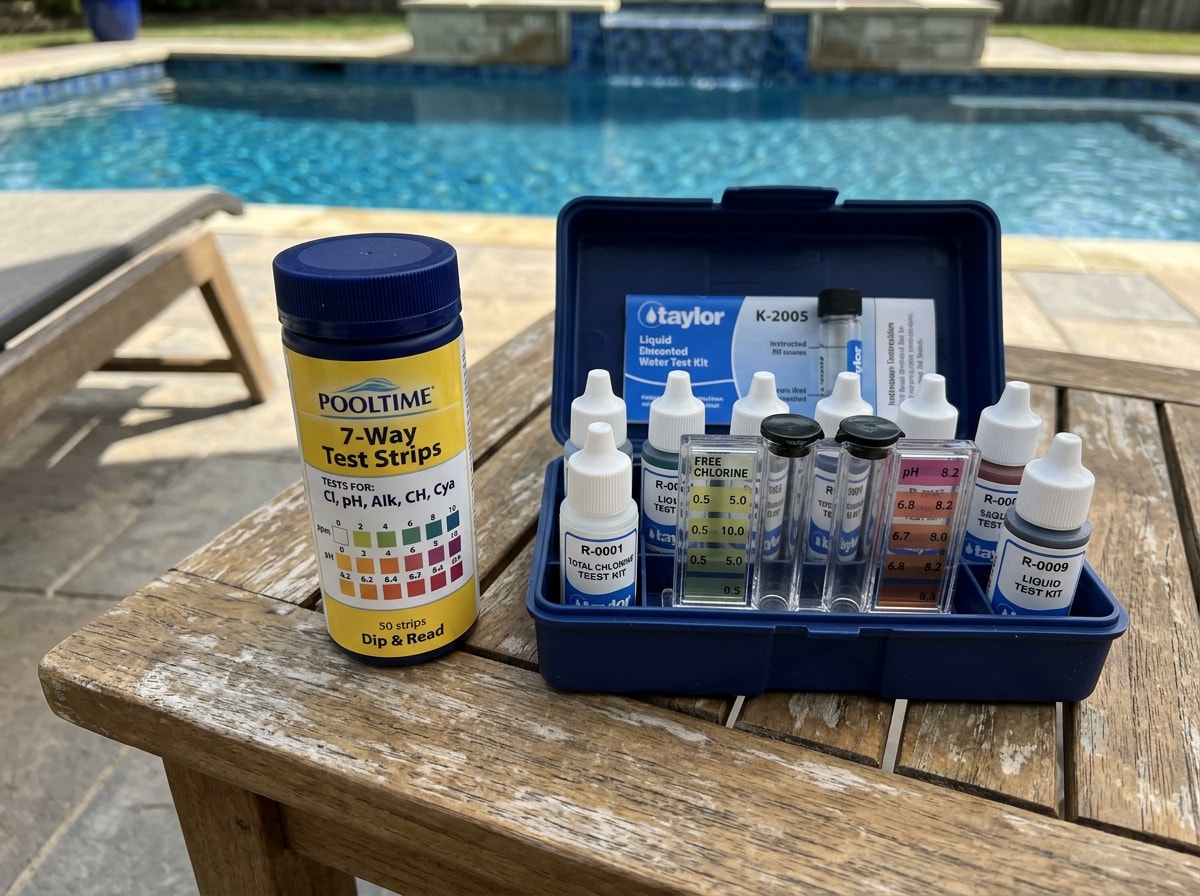
- Liquid test kits – a bit slower, but more precise and repeatable
- Professional water testing – slowest to arrange, but catches issues basic kits sometimes miss
Test Strips vs. Liquid Test Kits
Test strips are dip-and-read: quick, inexpensive, and good for a daily check of chlorine and pH. Liquid test kits use reagent drops and a color-match scale.
Liquid kits take a bit more time but deliver more detailed results, especially for alkalinity and calcium hardness. Both methods share one weak point: reagent quality.
Strips that have absorbed humidity give unreliable readings. So do liquid reagents left past their expiration date.
Store strips sealed and away from moisture. Replace liquid reagents annually. For routine DIY testing between professional checks, either method works as long as you watch the expiration dates.
When to Use Professional Pool Water Testing
Professional pool water testing confirms what a home test strip can only estimate. It also catches parameters basic kits often under-report, like cyanuric acid buildup.
A computerized water analysis usually checks seven to ten parameters at once, compared to the four or five on a typical strip, and produces specific dosing guidance a color-match strip can't offer. That level of detail matters when water stays cloudy or chlorine won't hold despite repeated dosing.
In our experience servicing pools across North Georgia, the readings that go sideways fastest after a heavy rain are total alkalinity and cyanuric acid, both of which are easy to misjudge on a basic strip. If your home readings keep looking off, get a free estimate and we'll run a full analysis to pinpoint exactly what's throwing off the balance.
How Often Should You Test Your Pool Water in Gainesville, GA?
As a baseline, test free chlorine and pH two to three times per week during swim season. Check total alkalinity weekly.
These three numbers shift fastest and have the biggest impact on comfort and sanitizer effectiveness. Certain events call for an extra test outside the normal schedule:
- Heavy rain, which dilutes chemicals and lowers pH
- A pool party or heavy bather load, which burns through chlorine faster than usual
- Adding any new chemical (shock, algaecide, stabilizer), which warrants a follow-up test a few hours later
Building this habit into weekly care for pools throughout the Gainesville, GA area catches small issues before they turn into algae blooms. If chlorine keeps disappearing faster than expected, it's worth checking your pH first, since the two parameters are tightly linked; our guide on how to raise pH in a pool quickly walks through the fix step by step.
Testing Frequency by Season
| Season | Recommended Testing |
|---|---|
| Spring / Summer (active swim season) | At least weekly; daily for pools with heavy traffic |
| Fall / Winter (low or no use) | Every two weeks to once a month |
Warm weather speeds up chlorine demand. Rising water temperatures accelerate sanitizer breakdown and algae growth, shifting chemistry faster than many owners expect, a pattern documented in university extension training materials on pool chemical management. Once temperatures drop and the pool sees less use, less frequent testing is usually enough.
A full-service check from our pool and hot tub service team at the start and end of swim season is a good way to catch anything a weekly strip test would miss. For broader project questions, our homepage outlines every service we run across North Georgia.
FAQ
Is pool water testing free in Gainesville, GA?
Many pool supply stores and service providers offer free walk-in water testing, often using a computerized analysis system. All that's typically required is a water sample of about 8 to 16 ounces.
Do I need an appointment for a water test?
Most in-store water testing is walk-in only, so an appointment usually isn't necessary. For a more thorough on-site visit with equipment inspection, scheduling ahead is a good idea.
How much does professional pool water testing cost?
In-store computerized testing is typically free when you buy chemicals or treatment products afterward. An on-site professional visit that includes equipment inspection and dosing is usually priced as part of a maintenance visit rather than billed separately. Ask for a quote up front.
How do I take a pool water sample?
Collect a sample in a clean container, dipping it elbow-deep near the middle of the pool, away from jets or skimmers. Cap it and test within a few hours, since chlorine levels drift quickly once exposed to light and air.
What is the ideal pH for pool water?
The ideal pool pH falls between 7.4 and 7.6, close to the natural pH of human eyes and skin. Staying in that window keeps chlorine working efficiently and prevents irritation.
When should pool water be tested more often?
Test after rain, after a party or heavy swimmer load, during heat waves, or anytime new chemicals are added. These events shift chemistry fast, and a follow-up test confirms the water stays balanced.
About the Author
This guide was written by the pool care team at Southern Life LLC, a Certified Pool Operator (CPO)-trained crew serving Gainesville, GA and the surrounding North Georgia area. Have a question about your own pool's chemistry? Contact us for a free estimate.