How much liquid chlorine to shock a pool in Marietta, GA depends on three things: your pool's gallon count, the strength printed on the jug, and how far your chlorine has dropped below breakpoint level. Get any one of those wrong and you'll either waste money or end up swimming in cloudy, chloramine-heavy water the next morning. Here's the exact math, the dosage chart, and the pour-by-pour steps that make it work the first time.
Key Takeaways
- Liquid chlorine dosing depends on product strength (10%, 10.5%, or 12.5%) as much as pool gallon count.
- Shocking means raising free chlorine high enough to hit breakpoint chlorination, the point where chloramines and contaminants fully burn off.
- Marietta's humid, rain-heavy summers mean shock treatments often need repeating every 1-2 weeks instead of monthly.
- Always confirm the dosage chart below against a current test kit reading before you pour anything.
Liquid Chlorine Shock Dosage Chart by Pool Size
For a routine shock, plan on roughly 1 gallon of 10% liquid chlorine (or about 0.8 gallons of 12.5%) per 10,000 gallons of pool water. Algae or heavy contamination pushes that to 1.5-3x the routine dose, depending on severity.
| Pool Size | Routine (10%) | Routine (12.5%) | Algae Shock (12.5%) | Heavy Algae (12.5%) |
|---|---|---|---|---|
| 5,000 gal | 0.5 gal | 0.4 gal | 0.8 gal | 1.2 gal |
| 10,000 gal | 1 gal | 0.8 gal | 1.6 gal | 2.4 gal |
| 15,000 gal | 1.5 gal | 1.2 gal | 2.4 gal | 3.6 gal |
| 20,000 gal | 2 gal | 1.6 gal | 3.2 gal | 4.8 gal |
| 30,000 gal | 3 gal | 2.4 gal | 4.8 gal | 7.2 gal |
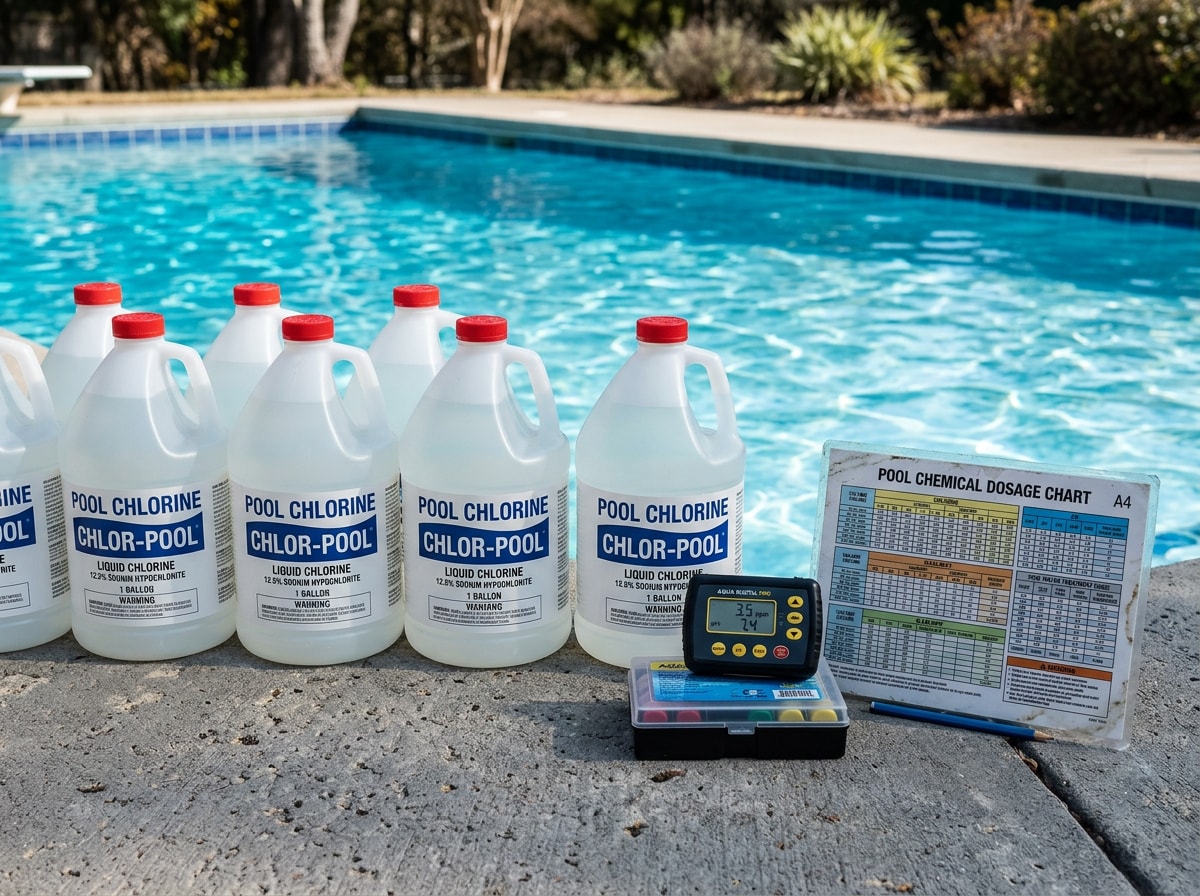
A stronger concentration always means less volume for the same result, since 12.5% liquid chlorine delivers more available chlorine per gallon than 10%. These numbers are a starting point, not a fixed rule. The real target is breakpoint chlorination: free chlorine needs to land at roughly 10 times your combined chlorine (chloramine) reading before contaminants actually burn off. A pool testing 0.4 ppm combined chlorine needs free chlorine pushed to about 4 ppm above where it currently sits, not just "some chlorine added." Skipping this math is the single most common reason a shock treatment doesn't clear the water.
Not sure which number applies to your pool, or don't want to deal with jugs and ppm math at all? Our pool and spa maintenance team handles dosing, testing, and the whole chemical routine for Marietta homeowners.
Why Georgia's Humidity and Rain Change Your Shock Schedule
Marietta's climate is harder on pool chemistry than a lot of national dosage charts account for. July is the wettest month in Marietta with about 5.4 inches of rain, and also the rainiest month with roughly 11.2 days of rain , which is exactly the kind of runoff that dilutes chlorine and washes organic debris into the water overnight. Add in average highs near 90.5°F paired with relative humidity around 70% during peak summer, and you've got ideal conditions for algae and chloramine buildup between visits.
In practice, that means a lot of Marietta pools need shocking every one to two weeks during June through August instead of the once-a-month cadence that works in drier climates. If you're constantly re-shocking and still fighting cloudy water, it's often a sign the underlying sanitizer system needs a second look. Homeowners switching away from tablet chlorine sometimes have better luck with a saltwater pool conversion, which generates chlorine on demand instead of relying on a storm-vulnerable chemical supply.
How to Shock a Pool With Liquid Chlorine, Step by Step
Step 1: Test and Balance the Water First
Test pH, total alkalinity, and combined chlorine before you touch the jug. CDC guidance calls for pool pH between 7.0 and 7.8 and a free chlorine concentration of at least 1 ppm , since that combination is what actually stops germs from spreading in the water. Chlorine added to a pool sitting at pH 7.8 or higher works far more slowly, so get pH down into the 7.2-7.4 range first if it's running high.
Step 2: Pour the Chlorine Correctly
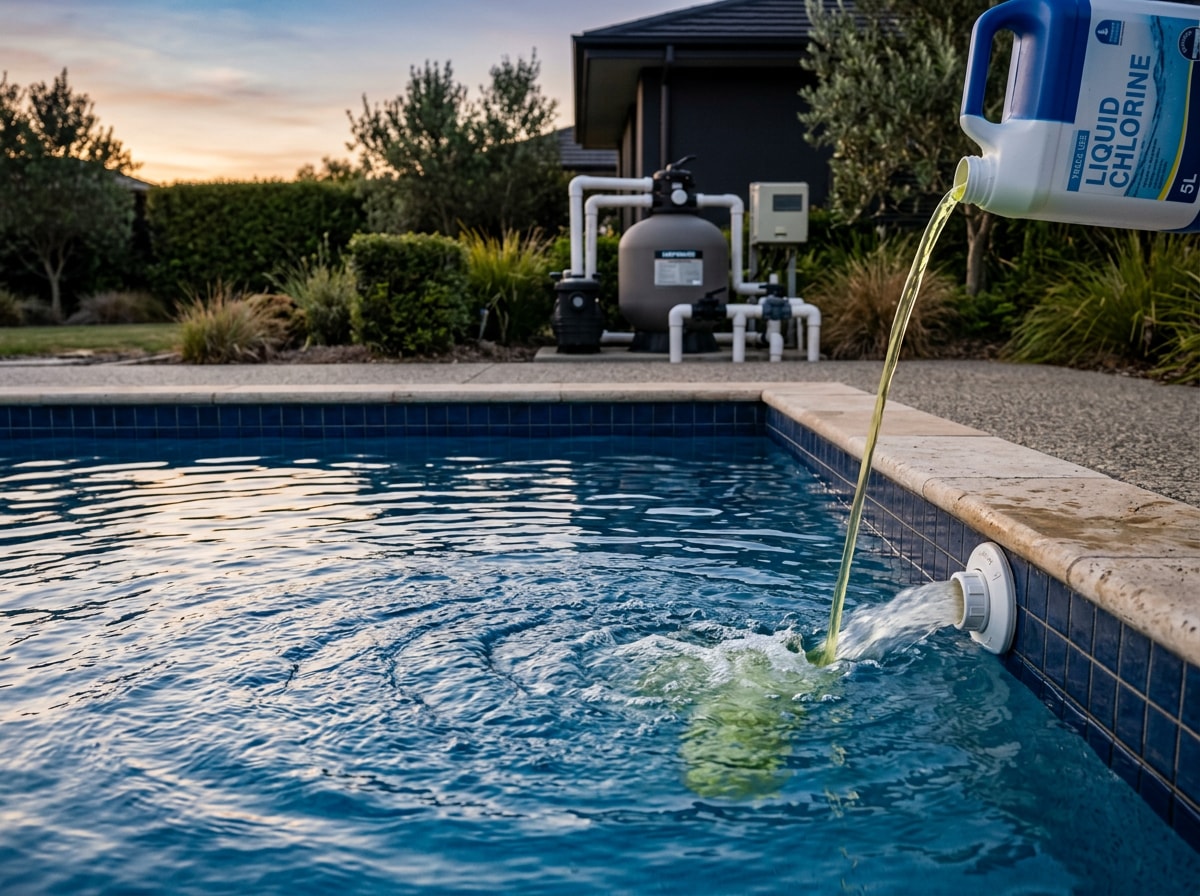
Run the pump, then pour liquid chlorine slowly around the pool's perimeter, concentrating near the return jets so circulation spreads it evenly instead of pooling in one spot. Industry guidance recommends pouring the liquid slowly while holding the container close to the water surface , since splashing concentrated chlorine from a height can bleach decking and clothing. Safety glasses or goggles and chemical-resistant gloves are required any time you're handling or applying concentrated sodium hypochlorite.
Because liquid chlorine is unstabilized, add it at dusk or after dark. Direct Georgia sunlight can burn off a meaningful share of the dose within hours if you shock at midday.
Step 3: Run the Pump and Retest
Keep the pump running at least 8 hours, ideally overnight, so the dose circulates fully. Don't let anyone back in the water until free chlorine drops to a safe 1-3 ppm range; levels run much higher right after a shock, and swimming too soon can irritate skin and eyes. Most pools need 8 to 24 hours to fall back into swim-safe range, depending on dose size, pump runtime, and sun exposure.
Treating Algae: When to Double or Triple the Dose
Visible algae changes the math. A green pool typically needs double the routine dose, while a thick, dark-green or black bloom can call for triple the standard amount before you see any shift. Start with the heavy-algae figures from the chart above, brush affected surfaces so chlorine actually reaches the algae, and run the pump continuously. Retest every few hours and repeat the shock if the water hasn't started clearing within 24 hours.
Liquid chlorine is considered one of the preferred shocking methods in the pool industry because high doses don't add calcium hardness or cyanuric acid to the water , which matters for algae treatments since you're often adding a lot of product at once. If two consecutive shocks don't clear a bloom, that's usually a sign of an underlying filtration or circulation problem rather than a dosing problem, and it's worth having a pool and hot tub service technician take a look before you keep adding chemicals blind.
Water Balance Targets That Make Shock Work
| Parameter | Target Range |
|---|---|
| pH | 7.2 - 7.6 |
| Total Alkalinity | 80 - 120 ppm |
| Calcium Hardness | 200 - 400 ppm |
| Free Chlorine (post-shock, safe to swim) | 1 - 3 ppm |
Georgia's rainwater runs naturally acidic, and a single heavy summer storm can drop both pH and alkalinity fast. Test and rebalance these numbers before you shock, not after, since chlorine added to poorly balanced water sanitizes less effectively no matter how much you pour.
We see this constantly on service calls across Marietta neighborhoods like East Cobb and Historic Marietta: a homeowner shocks the pool correctly by gallon count, but skips rebalancing after a storm, and the water stays cloudy anyway. If your readings are consistently off and you're tired of guessing, get a free estimate and we'll run a full water test as part of the visit.
FAQ
How long after shocking a pool can you swim in Marietta?
Wait 8 to 24 hours and retest before swimming. Free chlorine needs to drop back to the 1-3 ppm range; Georgia's summer heat and sun exposure can shorten or lengthen that window depending on pump runtime.
How much liquid chlorine do I need for a 15,000-gallon pool?
For a routine shock, use roughly 1.2-1.5 gallons of 12.5% liquid chlorine. That climbs to 2.4-3.6 gallons for an algae treatment, matching the ranges in the dosage chart above.
Are pool chlorine and pool shock the same thing?
No. Regular chlorine maintains a steady daily sanitizer level, while shock is a concentrated, one-time dose used to hit breakpoint chlorination and clear contaminants fast. Chlorine handles maintenance; shock handles a reset.
Does liquid chlorine add stabilizer (CYA) to the water?
No. Liquid chlorine is unstabilized and contains no cyanuric acid, so it won't raise CYA levels the way stabilized tablets do. The trade-off is faster burn-off in direct sunlight, which is why it's added at dusk.
How often should I shock my pool in Marietta during summer?
Most Marietta pools need shocking every 1-2 weeks from June through August because of heavy rain, high humidity, and heat. Pools under heavier bather load or recovering from a storm may need it more often.
Can you add too much liquid chlorine?
Yes. Over-shocking raises free chlorine well above safe swimming levels and can temporarily bleach liners or swimwear. Let it sit, keep the pump running, and retest every few hours rather than adding more on top of an already-high reading.
When to Call a Professional
Dosage charts get you most of the way there, but a pool that won't hold chlorine, clears slowly after every shock, or keeps clouding up after storms usually has something else going on, whether that's a filtration issue, a stabilizer level that's climbed too high, or aging equipment that can't keep up with Marietta's summer bather load. If you'd rather not troubleshoot that on your own, visit our Marietta, GA service area page or head to Southern Life LLC to see the full range of pool care we handle locally. For pool owners weighing a simpler seasonal routine, our write-up on above ground pool cleaning service pricing in Dawsonville breaks down what professional upkeep actually costs nearby.
Ready to stop guessing at gallons? Get a free estimate and we'll test your water, dial in the right shock dose, and get your pool back to swim-ready.
About the Author
This guide was written by the pool care team at Southern Life LLC, a Marietta-area pool and outdoor living contractor whose technicians hold NSPF Certified Pool Operator training and service pools throughout Cobb and Forsyth counties year-round. Questions about your specific pool? Contact us directly.